Coning/sculling controls at the original 200 Hz
9/9 new fits passed the predefined prediction/convergence checks. Three original fits were reused without refitting. The same synthetic increments, receiver timestamps and injected calibration are used throughout. There are no NASA input files, no observed-data starts and no change to the frozen archival integrator. See the predefined plan.
An IMU (inertial measurement unit) measures turning and acceleration. Ordinary integrals of those rates are not automatically equivalent to a finite rotation or a velocity change expressed in a single fixed frame when the instrument moves. Coning accounts for changing rotation axes; sculling/rotation compensation accounts for rotating specific force. Brouk and DeMars discuss these effects and their uncertainty propagation. This candidate's particular series is independently derived and tested here, not a claimed Applanix algorithm.
What changed
Each control is the existing 12-second, 220 m/s equatorial track at 1,000 m altitude, with known pitch/yaw, 24 receiver epochs and +0.25°/hour Z gyro offset. No samples are inserted or discarded. A new forward model estimates linear rate variation from three adjacent calibrated packet averages. Full integrals are preserved; partial packet predictions include that variation rather than scaling the entire packet uniformly. Calibration and latency derivatives include these corrections.
Five known-calibration modes separate the original predictor, linear partials, coning, rotating-force compensation, and both. Coning/sculling fits use the original solver from zero, with the same six nuisance bounds and synthetic 1 cm position scale. Nonzero approximation errors are retained. Independent continuous differential equations check constant-rate, single-axis and changing-axis packet behavior. Disabled corrections reproduce the old values and derivatives exactly.
Calibration fits
| True model | Method | Prediction check | Z offset error (°/hour) | Largest position error (m) |
|---|---|---|---|---|
| sphere_rotating | baseline | reused | 0.6462874259762825 | 4.572913867509711e-06 |
| sphere_still | baseline | reused | 0.5380627440836028 | 5.019167586869395e-06 |
| flat_still | baseline | reused | 0.451168252657868 | 5.205940466825125e-06 |
| sphere_rotating | coning | True | 0.6128621554185238 | 4.6589985105944576e-06 |
| sphere_rotating | sculling | True | 0.03041478010010207 | 8.462359057899145e-08 |
| sphere_rotating | combined | True | -1.0380442457893937e-05 | 4.0490216617968197e-10 |
| sphere_still | coning | True | 0.4967510576573305 | 5.087152613875235e-06 |
| sphere_still | sculling | True | 0.03471548614072839 | 6.67238109894388e-08 |
| sphere_still | combined | True | -5.475725546172891e-06 | 1.9124995738510818e-10 |
| flat_still | coning | True | 0.41662668970394023 | 5.2606896513272115e-06 |
| flat_still | sculling | True | 0.035677104784754124 | 5.532917456581546e-08 |
| flat_still | combined | True | 0.00037653280142348086 | 1.7159852849613274e-09 |
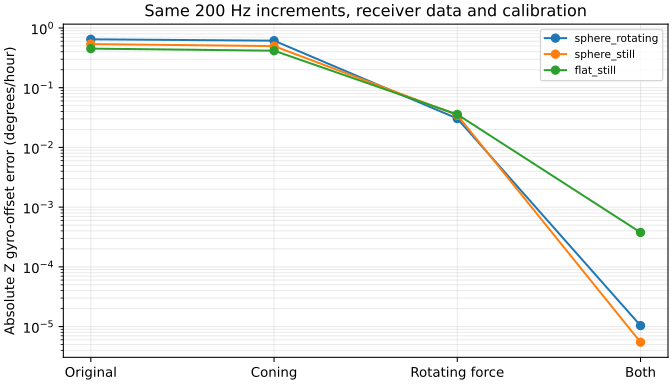
The plot shows absolute offset error with a 10⁻¹²°/hour display floor only. Signed errors, gains, objectives, active limits and failures are retained in comparisons.csv and complete saved diagnostics. A small position error or successful stop alone does not establish correct calibration.
Predictions at the injected calibration
| True model | Method | Largest position error (m) |
|---|---|---|
| sphere_rotating | baseline | 4.10436e-05 |
| sphere_rotating | linear | 4.10436e-05 |
| sphere_rotating | coning | 1.96112e-05 |
| sphere_rotating | sculling | 3.51847e-05 |
| sphere_rotating | combined | 2.56293e-10 |
| sphere_still | baseline | 4.11712e-05 |
| sphere_still | linear | 4.11712e-05 |
| sphere_still | coning | 1.96755e-05 |
| sphere_still | sculling | 3.5298e-05 |
| sphere_still | combined | 2.56446e-10 |
| flat_still | baseline | 4.12039e-05 |
| flat_still | linear | 4.12039e-05 |
| flat_still | coning | 1.96906e-05 |
| flat_still | sculling | 3.53228e-05 |
| flat_still | combined | 2.56186e-10 |
These predictions use the known calibration, with no fitting. The linear-only row isolates changed within-packet receiver timing from the higher-order corrections. Each mode is used equally under all three true model identities; this is numerical qualification, not choosing an Earth model from real observations.
Scope and next decision
The candidate assumes ordinary integrated rates and truncated within-packet series. It explicitly refuses enabled corrections for already-compensated input. The tests do not establish which convention Applanix logged or whether all required onboard corrections were applied. Frame rotation, Coriolis, position integration and gravity retain the original geographic midpoint treatment. Noise, longer records, full nuisance freedom and installation transfer remain separate qualifications.
Do not apply this candidate to NASA records merely because it improves these known synthetic controls. First assess recovered calibration and remaining errors, then qualify increment conventions and equally specified alternatives. Preserve original measurements and results. Any observed comparison needs a separate finite allowance.
The completed report charged nine starts, with no retries, and used 359 new native sweeps within its 1,815-sweep ceiling. Baseline work was reused. Packaging reads saved results and starts no fits:
env PYTHONPATH=analysis MPLCONFIGDIR=/tmp/lll-compensation-matplotlib ~/venv/bin/python docs/ilvis0-compensation-controls-20261011/build_report.py --package-only