The advantage persists when later GPS positions are withheld
The saved calculations contain a useful empirical check. Calibration uses the first 4.85 minutes of one IMU21 recording. The later IMU (inertial measurement unit) readings continue the reconstructed track for another 2.43 minutes; later GPS positions are withheld from calibration and used to assess its errors. There is no GPS reset at the split.
Three matched settings have all three source optimizations completed. Their direct errors are:
| Model | Training horizontal RMS | Later horizontal RMS | Later vertical RMS |
|---|---|---|---|
| Globe + specified field | 0.041–0.042 m | 2.38–2.45 m | 3.23–3.33 m |
| Globe, zero field | 25.26–29.35 m | 142.91–160.56 m | 1.98–2.03 m |
| Flat disc | 8.69–14.08 m | 165.96–255.36 m | 2.16–3.17 m |
RMS summarizes the typical size of the errors over each period. The advantage is already present in training and persists after later GPS positions are withheld. These models did not start the prediction period with equally good training fits. Vertical error alone does not give the same ordering; both horizontal and vertical performance matter.
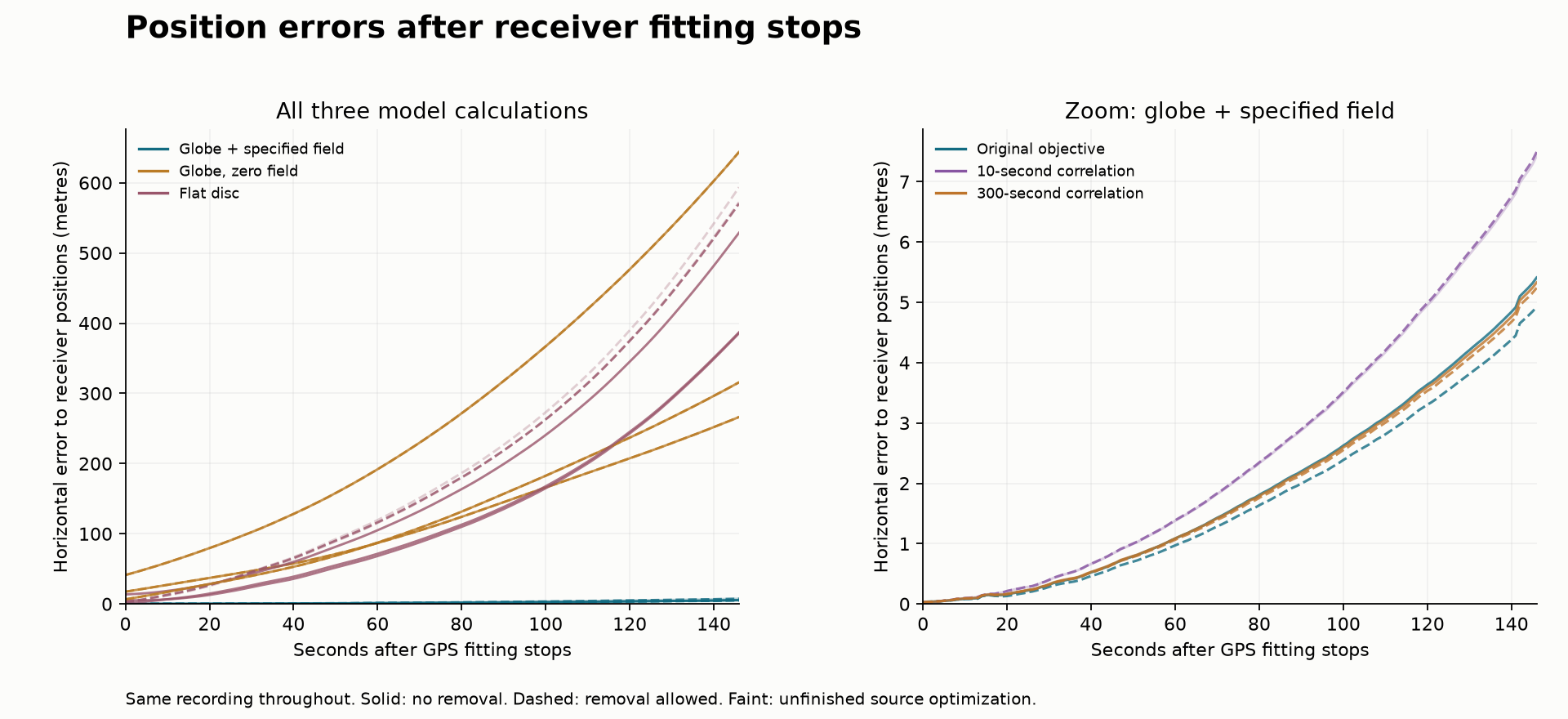
The complete audit includes all 18 saved fits, under three fitting/error assumptions and two processing cases. Fifteen passed their original stopping checks; three remain unfinished. All use the same recording and the same receiver split, not eighteen independent flights. The three incomplete matched settings remain visible; their missing best fits are not counted as equal support for the models.
This adds no new fit, model preference or independent replication. It verifies the saved epoch errors against their original summaries and keeps their stopping labels unchanged. The recording had already informed development, calibration uncertainty is not covered by these error curves, and no calibrated absolute adequacy threshold or detection significance follows from them.
Source and every comparison · Comparison CSV · Fixed error sections · Next analyses.