The gyro traces with the specified background field removed
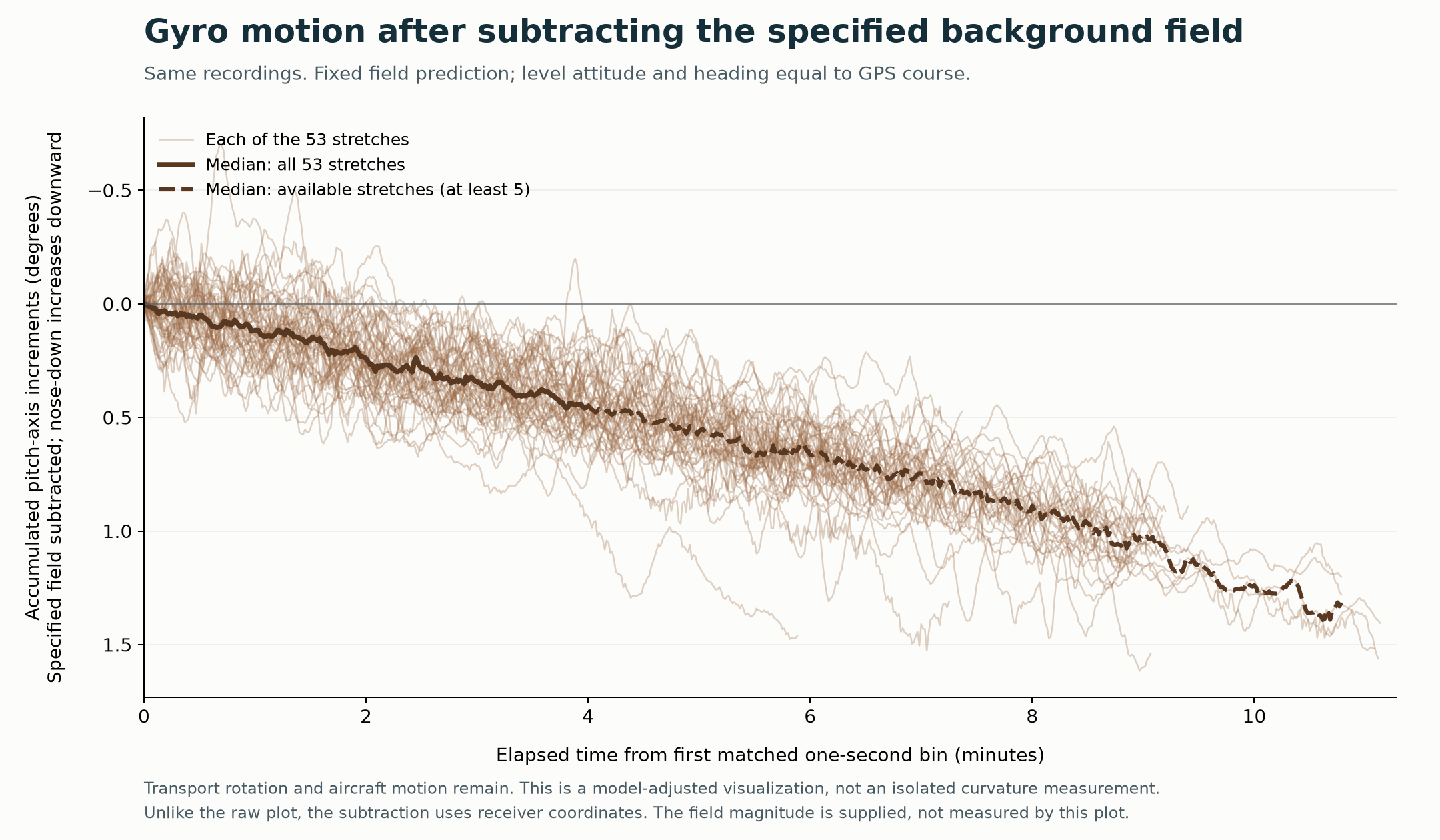
All 53 traces still finish nose-down. Their final accumulated values range from 0.24° to 1.56°, with a median of 0.92°. These are different-length stretches; the endpoint median is not the median angle at one common time.
This uses exactly the same 25,433 one-second gyro bins as the original raw plot. No bins were dropped or filled. The thin lines are individual stretches. The solid median covers the common interval; the dashed median uses the shrinking set still recording.
What was subtracted
An IMU (inertial measurement unit) records turning and specific force. From its recorded pitch-axis turning, this display subtracts the contribution predicted by the specified background rotation field: approximately 15.04°/hour projected onto that axis using latitude and travel direction.
The calculation assumes level attitude and aircraft heading equal to GPS course. It supplies the field's standard magnitude and direction; it does not measure them independently or identify the field's cause. Unlike the original raw plot, this correction uses GPS coordinates. It assumes the full specified field was retained in the logged increments, with no upstream removal.
Only that field contribution is removed. Turning associated with transport over the surface, aircraft attitude changes, mounting uncertainty and instrument errors remain. This is a model-adjusted visualization, not a new curvature test. No calibration or field magnitude was fitted, and no fused navigation attitude or gyro rate was used.
Why the largest raw traces are not steep descents
The two largest raw endpoints come from overlapping recorders on the same flight leg. The largest accumulates 2.68° in 11.1 minutes, but its receiver height spans only 26 metres around 9.25 km altitude, ending about 19 metres lower. Its background-subtracted endpoint is 1.56°. A gyro-axis sum is not simply the change in the aircraft's nose angle relative to the horizon.
The intervals passed the steady-flight selection, which allows small vertical motion and course corrections. The selection does not require perfect altitude hold or eliminate all pitching. Several recorders overlap; 53 curves are not 53 independent flights.
Full-size image · Vector image · Plotted values · Endpoint table · Method and finite scope · All stretches.


The reproducible builder checks input hashes and agrees with the existing geographic companion's signed totals. It reads saved measurements only; there are no new aircraft fits or raw-file decoding.